It happens constantly. You check your rank tracker. The keyword you actually care about—the one that might bring in actual money—isn't buried on page ten anymore. It’s right there on page two. Position 12. Position 14.
And then it just stays there. Forever.
This is the most toxic place your keyword can be. Mainly because it gives you false hope. You feel like you're one tiny push away from the first page, so you start making all these minor, nervous edits.
You tweak the meta title. Nothing. You shove an FAQ block at the bottom of the page. Still nothing. You point a random internal link at it. Maybe it jumps to position 11 for a day, and then drops back down.
If you are stuck in this loop, just stop. Page two doesn’t happen because you forgot a couple of keywords in your subheadings. It happens because Google doesn’t trust the page enough to put it in front of a real audience.
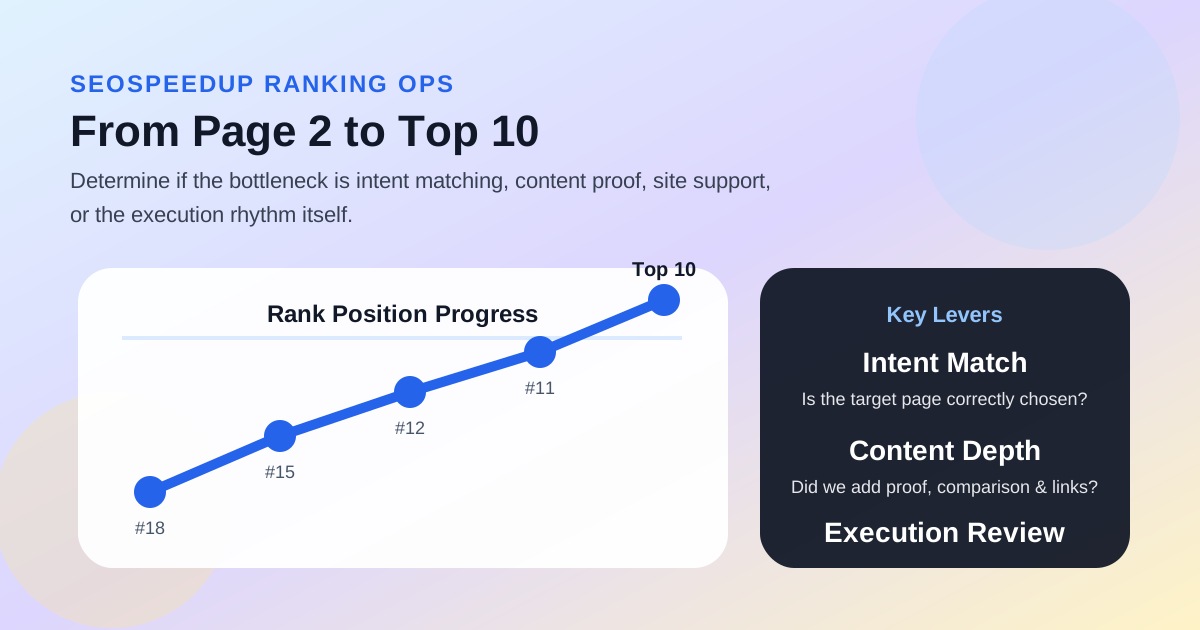 Before you touch your CMS, map out why you're stuck.
The usual suspects (Why you are probably stuck)
When people get close to page one, survival instinct tells them to just push harder on whatever page is ranking. Usually, that's entirely the wrong move.
Here are the biggest screw-ups we see every week:
- You picked the wrong horse. Trying to force a product landing page into a search results page entirely populated by Wikipedia and long-form guides.
- Obsessing over the title tag. Wasting hours on the perfect clickbait title when the actual article underneath is 400 words of generalized junk.
- The island problem. The page itself is fine, but the rest of the website has never covered this topic before. It has zero topical authority.
To fix this, you have to run through a mental checklist.
Is it actually dead, or is it just twitching?
Don't touch your page until you know if Google is still calculating where it belongs.
Run your URL through the Search Engines Checker and look at the actual history.
Are you getting wild swings? Position 12 on Tuesday, position 20 on Thursday, back to 14 by the weekend? If it’s violently fluctuating, the algorithm is testing you. It’s comparing your page against others. You might just need a couple of strong internal links from related blog posts to tip the scales.
But if you’ve been glued to position 15 for three straight months? The algorithm made up its mind. Minor tweaks won't cut it. You need surgery.
Stop throwing words at the wrong page
We see this all the time. People refuse to check search intent once a keyword ranks anywhere in the top 20.
Throw the keyword into our SEO Analyzer or just look at Google yourself. What is actually sitting on page one?
If every single result on page one is a listicle ("Top 10 Best CRMs"), and you're trying to rank a hard-sell sales page for your specific CRM software... you lose. It doesn't matter how great your sales page is. Google decided searchers want options, not a pitch.
If you have fundamentally the wrong answer to the search query, adding 500 words to the bottom of the page is a waste of time.
Thin content versus missing signals
If the intent is a match, you've got one of two problems.
Problem A: You don't actually say anything useful
You have the right topic, but the content is just surface-level noise. You talk about the subject, but you don't show real examples. You don't provide data. You give the reader no clear way to make a decision.
The fix: Build out comparison tables. Give specific case studies. If you have no idea how to structure this, run the concepts through our AI Article Generator for a baseline outline, or throw your badly-written paragraphs into the AI Text Rewriter to sharpen them up.
Problem B: Your signals are a total mess
The writing is incredible, but your metadata is actively contradicting it. Your title tag has nothing to do with the main keyword. You have multiple pages on your own website fighting for the same exact term (cannibalization).
The fix: Force the AI TDK Rewrite Tool to clean up your metadata so it aligns. Run the page through the SEO Friendly URL Checker and fix any broken canonicals. Stop confusing the crawler.
You can't rank one page on an island
Here is the dirty secret of page two: Sometimes, the target page is perfect. The problem is the rest of your website.
If you wrote a world-class guide on "technical SEO audits," but the rest of your blog is about dog grooming and generic marketing advice... Google doesn't trust you to be the authority on technical SEO.
You need backup. Write a supporting blog post. Build out a glossary covering related terms. Then, point internal links from all those new cluster pages directly to your target guide.
(If building these workflows sounds like a nightmare, we broke down how to systemize this exact thing in Why Keyword Optimization Fails).
Treat it like a real project (Start tracking)
If you just randomly change sentences whenever you feel panicked, you'll never know what actually worked.
Write it down. Put it in a spreadsheet.
- The keyword: The exact phrase.
- The URL: The target page.
- Current position: e.g., Hovering around 14.
- The hypothesis: E.g., "Page intention is okay, but we have zero internal links."
- The action: "Added 4 internal links from the AI tools cluster."
- Review timeline: Check back in 14 days.
Or just plug the whole thing into the Keyword Optimization Service dashboard and let the tool keep the paper trail for you.
The quick-fix cheat sheet
If you just want to know what to do right this second, here is how we handle it:
| The Situation | What it probably means | What to do next |
|---|---|---|
| Huge swings (11 to 20 and back) | Algorithm is unstable/testing you. You lack deep authority. | Push a new supporting blog post and internal link immediately. |
| Flatlined at 14 for months | Wrong intent or deeply insufficient content. | Compare your page side-by-side with the top 3 results. Rewrite the missing angles. |
| Lots of impressions, terrible clicks | The snippet in Google looks awful. | Rip up the Title and Meta Description. Make it clickable. |
| People click but leave instantly | You bait-and-switched the searcher. | Put the actual answer to the search query immediately in the first paragraph. |
Ranking on page two means you are relevant. To get to page one, you have to be undeniable. Stop guessing, check the data, and fix the actual bottleneck.