Many websites fail to rank not because they lack content, but because too many of their own pages are fighting over the exact same keyword.
The most frustrating part of keyword cannibalization is that it’s a silent killer. Unlike a 404 error or a rogue noindex tag, your site won't throw a technical alert. On the surface, you might proudly think, "We have so much great content on this topic." But what the search engine sees is a messy cluster of overlapping themes, unclear page roles, and diluted authority.
The ultimate result? The ranking signals that should have consolidated into one powerful target page are instead fractured across a blog post, a tool page, a service page, and an archived category. None of them rank well.
If you are currently pushing keywords and find your team arguing over "which page is actually supposed to rank for this," you don't need to write more words. You need to enforce strict page hierarchies.
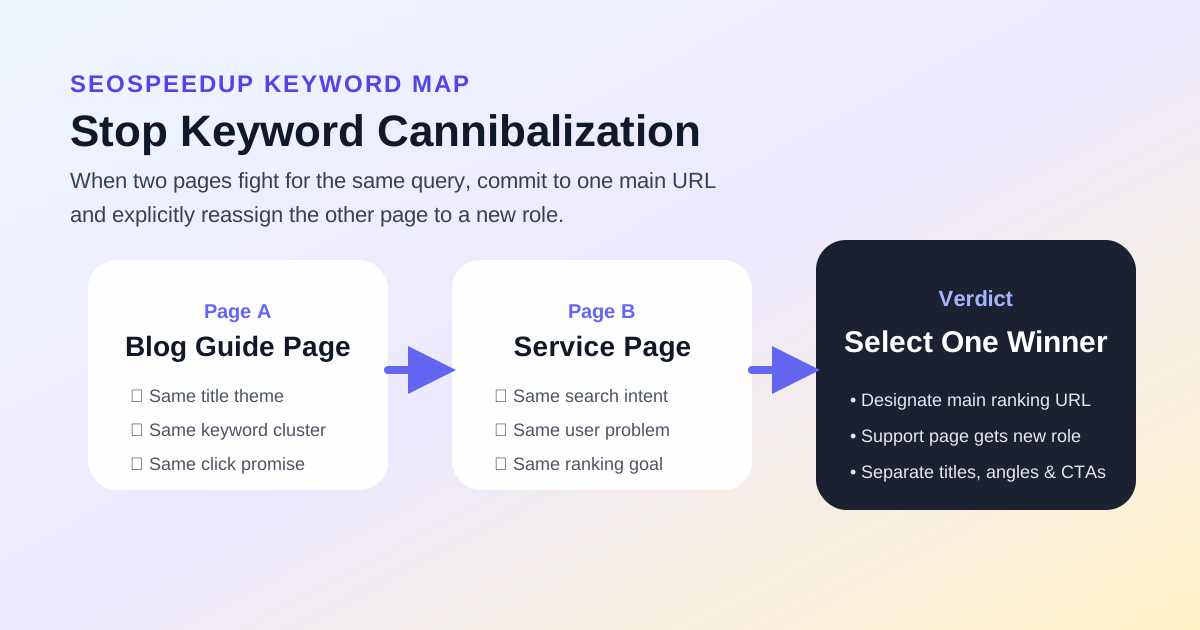 The core of keyword cannibalization isn't having 'too many pages'; it's having multiple pages doing the exact same job. Pick your apex predator page, and assign supporting roles to the rest.
What Does Keyword Cannibalization Look Like in the Wild?
In real-world SEO projects, I consistently see these 4 disastrous patterns:
1. The Blog Post vs. The Service Page
Your marketing team writes a blog post that gradually sounds more and more like a sales pitch. Meanwhile, your service page tries to capture long-tail informational queries by adding massive "How-To" sections. They meet in the middle, and Google can't tell which one is the actual commercial offering.
2. The "New Year, New Article" Syndrome
Every time the team revisits a core topic, they write a brand-new article rather than updating the old one. Fast forward six months, and your domain has four articles with different titles but the exact same core answer.
3. The Tool vs. The Documentation
A Tool page should capture the intent: "I want to execute this task right now." A Documentation page should capture: "I want to understand how this task works." If their Titles, Meta Descriptions, and H1s look identical, they will cannibalize each other in the SERPs.
4. The Ghosts of Migrations Past (Old vs. New URLs)
This is the stealthiest variant. You launch a redesign with new URLs, but the old URLs are still live. Canonicals, internal links, and external anchor text are still pointing to the legacy pages. The team thinks the "new design is failing," when in reality, the site just hasn't completed its authority migration via 301 redirects.
How Do You Diagnose True Cannibalization?
Don't just stare at ranking trackers. Ask these 3 questions first:
- Are these competing pages answering the exact same Search Intent?
- Are their Titles and Meta Descriptions using the exact same keyword phrasing?
- If a user clicked on both, would they feel like they are reading the same solution?
If you answer "Yes" to two out of three, congratulations: you don't have a "Topic Cluster." You have Keyword Cannibalization.
In SeoSpeedup, we diagnose this by running the URLs through the SEO Analyzer to assess their on-page signals, and then checking the Search Engine Rank Checker to see if multiple URLs are violently swapping positions for the same keyword week over week.
The Bulletproof Fix: Crown the King, Repurpose the Rest
When teams discover cannibalization, their first instinct is usually to "make every page stronger." That is fundamentally the wrong move.
The correct, stable sequence is:
Step 1: Crown the Primary Page (The Apex Page)
The selection criteria should be ruthless:
- Which page best completely satisfies the user's true search intent?
- Which page drives the actual commercial action/conversion you want?
- Which page has the strongest existing backlink profile and internal link equity?
Rule of Thumb: If the keyword has high commercial intent, the Service or Tool page must win. If the keyword is purely educational, the Blog or Guide page must win.
Step 2: Demote and Repurpose the Competitors (The Supporting Cast)
Once the Primary Page is crowned, you don't necessarily have to delete the competing pages, but you must change their job descriptions.
Standard tactical moves:
- Demote to Supporting Content: Shift the angle of the competing page to a highly specific sub-topic or a vs. comparison, abandoning the broad head-term.
- De-optimize: Strip the primary keyword out of the competitor's Title, H1, and Meta Description.
- Consolidate (301 Redirect): If the competing page offers zero unique value, merge its best paragraphs into the Primary Page and 301 redirect the URL.
- Internal Linking: Force the competing page to link up to the Primary Page using exact-match anchor text.
This step is far more effective than just mindlessly deleting content. Most cannibalizing pages aren't worthless; they just have an ego problem.
The SeoSpeedup Workflow for Resolving Cannibalization
If you need to untangle a cannibalization mess right now, follow this sequence:
1. Audit Current Roles with /seo
Use the SEO Analyzer to determine:
- Do the Title and Body text align?
- Is this page accidentally optimized for a role it shouldn't have?
- Are there technical anomalies (like broken canonicals) splitting the indexing signals?
2. Identify the Fluctuations with /tools/search-engines-checker
The Rank Checker will confirm the cannibalization:
- Is Google swapping out the ranking URL for this keyword every few days?
- Has the target keyword fundamentally failed to stabilize on your intended landing page?
If Monday shows your Blog ranking, and Thursday shows your Service page ranking, you have fractured signals.
3. Re-Align the Signals with /ai/title-generator and /ai/tdk-rewrite
When repurposing pages, the most frequently forgotten elements are the Title and Description.
Deploy these tools to force alignment:
- AI Title Generator: Find a narrower, non-competing angle for the supporting pages.
- AI TDK Rewrite Tool: Push the Titles, Meta Descriptions, and tone of voice back into their designated lanes.
The Ultimate Misunderstanding: "Topic Clusters" vs. "Content Duplication"
Many marketers read about "Topic Clusters" and aggressively spin up dozens of articles around a single theme. The problem? Expanding word count is not the same as dividing labor.
A healthy Topic Cluster looks like a solar system:
- The Pillar Page targets the broad core keyword (The Sun).
- Supporting Pages target specific sub-queries (Planets).
- Comparison Pages target alternative intents (Moons).
If all your pages are just explaining the exact same broad topic using slightly different synonyms, you aren't building a cluster. You are building a civil war.
The Actionable Page Role Matrix
If you need to align your content and dev teams quickly, use a brutalist matrix like this:
| Page URL | Current Keyword Target | True Page Role | Keep Primary Keyword? | Next Action / Execution |
|---|---|---|---|---|
| Blog Post A | "SEO Audit Tool" | Educational / Concept | No | Rewrite Title to "Why Audits Matter", link up to Service Page B. |
| Service Page B | "SEO Audit Tool" | Commercial / Conversion | Yes | Reinforce keyword density, add case studies and lead forms. |
| Glossary Page C | "SEO Audit" | Definition / Quick Answer | No | Strip keyword from H1, point canonical or internal link to Service Page B. |
The value of this matrix is that it forces a brutal decision for every URL:
Is this page responsible for 'Educating', 'Executing', or 'Converting'?
Conclusion: Establish Hierarchy Before You Push Ranks
The root cause of keyword cannibalization is never "we wrote too many articles." It is always "our pages look too similar to a machine."
Stop writing, and start organizing:
- Audit roles using the SEO Analyzer.
- Track URL fluctuations with the Rank Checker.
- Crown the apex page.
- Demote supporting pages by rewriting their SEO signals.
- Finally, resume pushing your chosen victor via our Keyword Optimization Service.
If you are currently restructuring your keyword maps, you need to read these next: